Read the complete essay as text
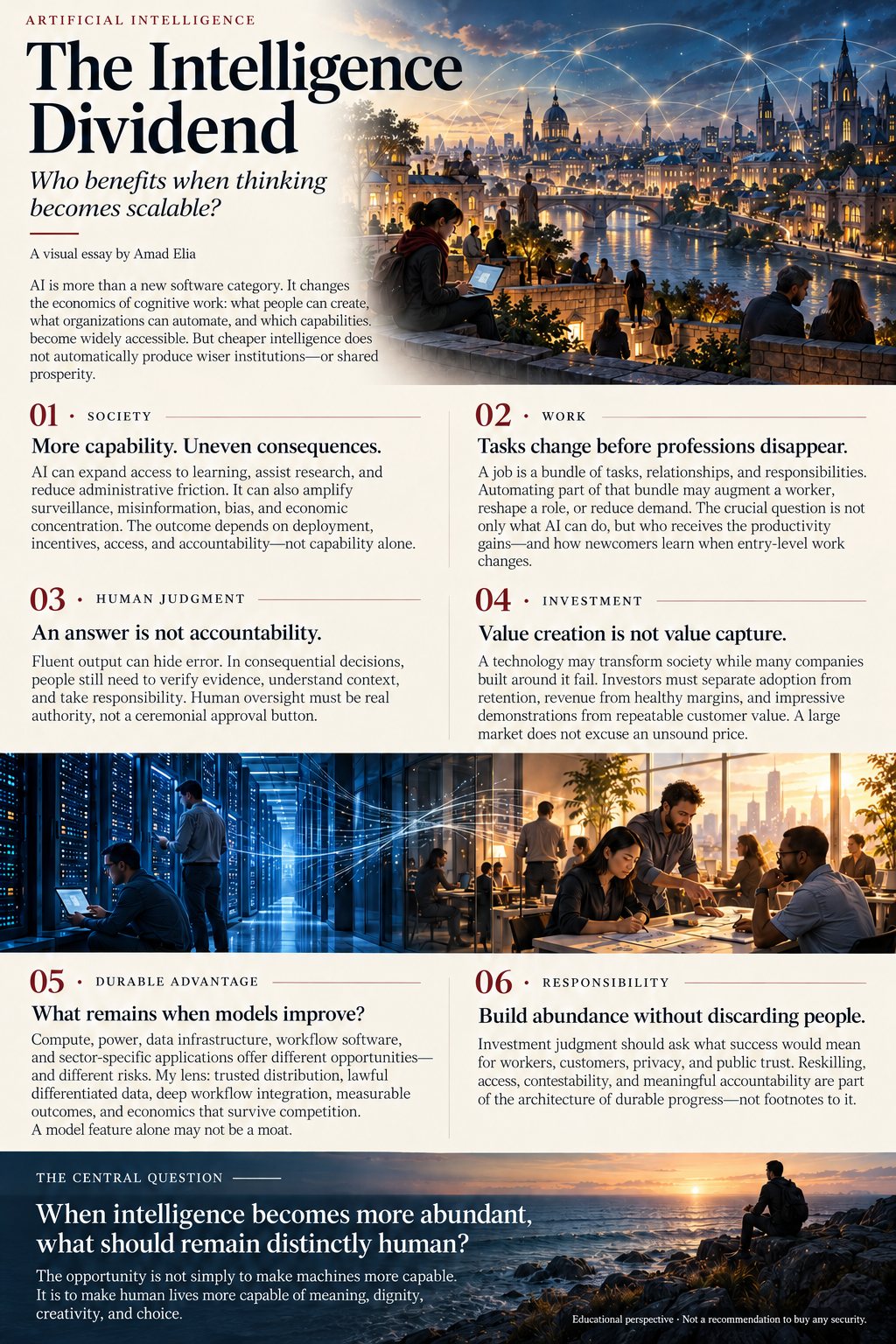
AI is more than a new software category. It changes the economics of cognitive work: what people can create, what organizations can automate, and which capabilities become widely accessible. But cheaper intelligence does not automatically produce wiser institutions—or shared prosperity.
More capability. Uneven consequences.
AI can expand access to learning, assist research, and reduce administrative friction. It can also amplify surveillance, misinformation, bias, and economic concentration. The outcome depends on deployment, incentives, access, and accountability—not capability alone.
Tasks change before professions disappear.
A job is a bundle of tasks, relationships, and responsibilities. Automating part of that bundle may augment a worker, reshape a role, or reduce demand. The crucial question is not only what AI can do, but who receives the productivity gains—and how newcomers learn when entry-level work changes.
An answer is not accountability.
Fluent output can hide error. In consequential decisions, people still need to verify evidence, understand context, and take responsibility. Human oversight must be real authority, not a ceremonial approval button.
Value creation is not value capture.
A technology may transform society while many companies built around it fail. Investors must separate adoption from retention, revenue from healthy margins, and impressive demonstrations from repeatable customer value. A large market does not excuse an unsound price.
What remains when models improve?
Compute, power, data infrastructure, workflow software, and sector-specific applications offer different opportunities—and different risks. My lens: trusted distribution, lawful differentiated data, deep workflow integration, measurable outcomes, and economics that survive competition. A model feature alone may not be a moat.
Build abundance without discarding people.
Investment judgment should ask what success would mean for workers, customers, privacy, and public trust. Reskilling, access, contestability, and meaningful accountability are part of the architecture of durable progress—not footnotes to it.
When intelligence becomes more abundant, what should remain distinctly human?
The opportunity is not simply to make machines more capable. It is to make human lives more capable of meaning, dignity, creativity, and choice.
Educational perspective · Not a recommendation to buy any security.